
RoastRig
A Coffee Bean Roaster Designed for Viewing the Roasting Process
Designed for Stanford Medicine
Role
Door & Viewing-Port Design; System Test
Team
Five-person engineering team
Sponsor
Stanford Product Realization Lab
Tools
Fusion 360, CNC machining, water jet, rapid prototyping, thermocouples, arduino
The Challenge
Professional roasters need precise heat and drum control while seeing how beans move and change color. The front interface had to provide a clear view, retain heat, support temperature measurement, open for unloading, and prevent beans from escaping through the small gap between the rotating drum and stationary door.
The Solution
RoastRig uses a hinged, latched aluminum door with a six-inch borosilicate-glass viewport. The integrated assembly provides visibility of bean lofting, a location for the bean-mass thermocouple, heat retention, and full access for unloading. Interface geometry and operating angle were refined so the spinning drum could run without spilling beans into the chassis.

My Contribution
I designed, built and integrated the door and viewing-port subsystem and helped validate the final prototype roaster under realistic operating conditions.
Design
Designed the aluminum door and six-inch glass viewport around visibility, heat retention, probe placement, cleanability, and bean unloading.
Integration
Fit the stationary front assembly to the rotating drum, refined clearances, and helped prevent beans from falling into the chassis during rotation.
Test
Helped evaluate preheat temperature, drum rotation, bean lofting, retention, and full-cycle roasting performance.
Design, Integrate & Test

The hinged, latched door gives direct drum access while the viewport and insulated perimeter retain heat during operation.
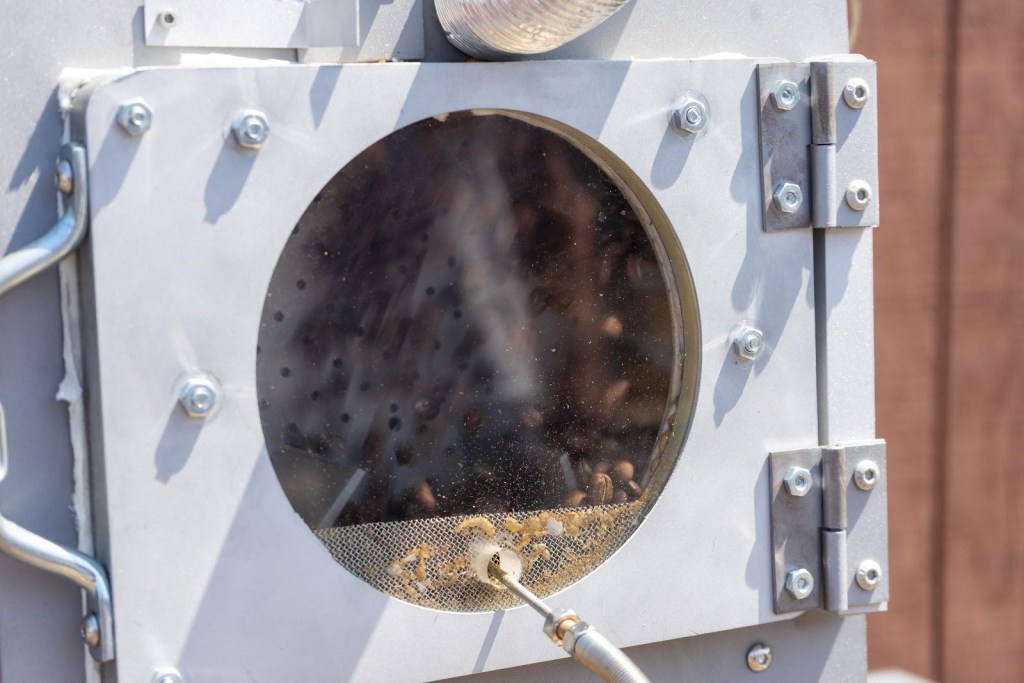
The port lets the operator monitor bean movement and color while a thermocouple measures bean-mass temperature.

The door opens fully and the chassis pivots forward to transfer roasted beans into the cooling tray.
Engineering Through Testing

Consisting of the roaster attached to the chassis with a bean catcher bellow the roaster.

Early agitation testing showed that loft trajectory of the beans was best when using six short fins spaced evenly in the drum.

Thermocouple testing verified heat at multiple points and confirmed the roaster could maintain heat at 235°C
Results
235°C
Target preheat achieved
< 30 min
Time to target temperature
Successfully Roasts
Roasts 30 ounces of beans at once
The final system reached the required internal temperature, visibly progressed through yellowing and first crack, produced adequate bean lofting with no tipping or facing, and transferred the roasted batch into the cooling tray.